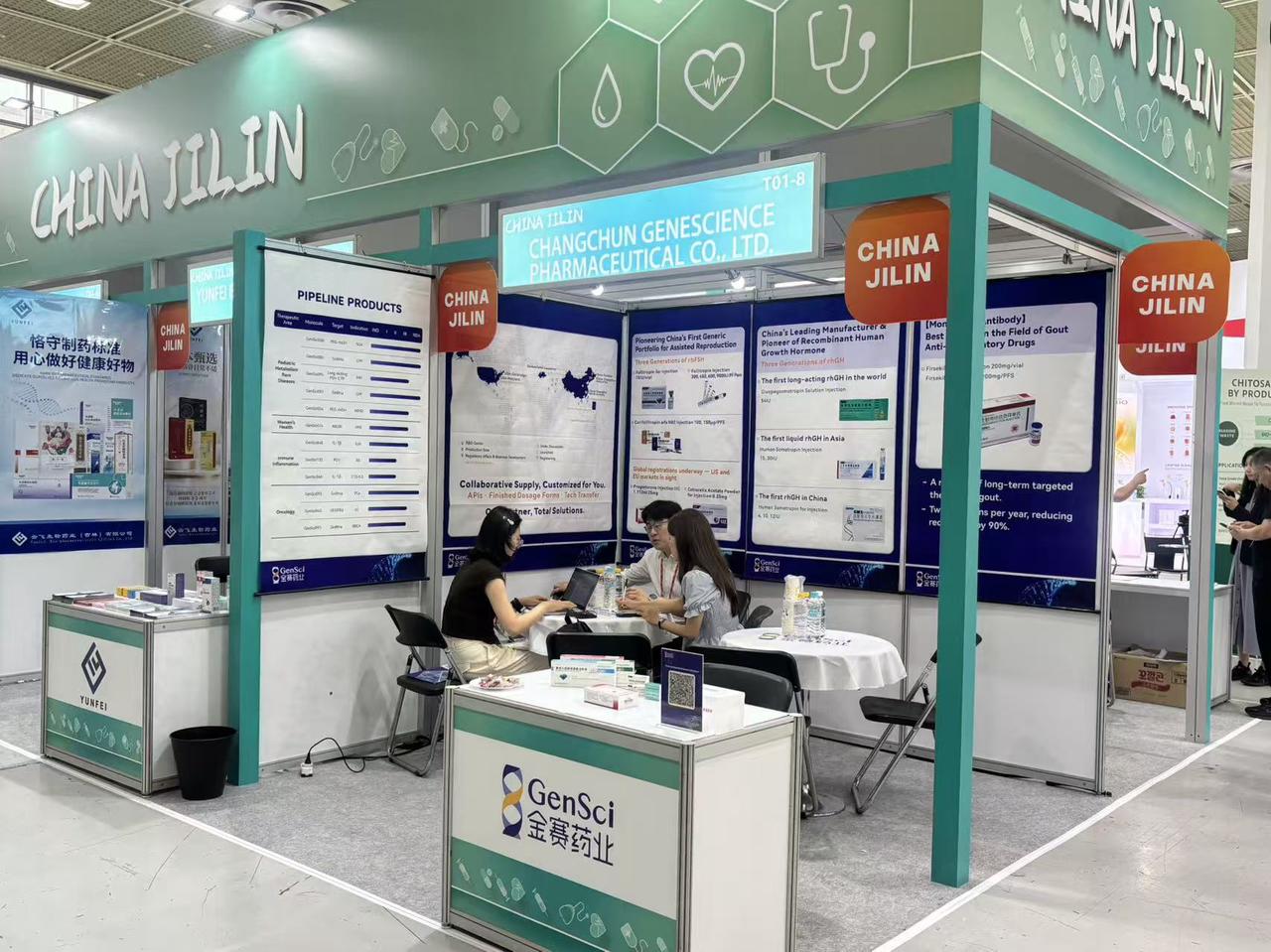
GenSci's Firsekibart Injection Receives Approval by NMPA

Time
2026-05-07

Readership
8358
Share


Recently, GenSci's Firsekibart Injection(liquid formulation) has officially received approval from National Medical Products Administration (NMPA). It is indicated for gouty arthritis (GA) treatment in adult patients for whom NSAIDs and/or colchicine are contraindicated, not tolerated, or ineffective and for whom repeated courses of corticosteroids are not suitable. Compared with the powder formulation, the upgraded aqueous formulation eliminates the need for reconstitution and preparation, offering greater convenience and effectively improving patient compliance.
Statistics show that China has over 180 million patients with hyperuricemia and more than 30 million gout patients, with a trend toward younger onset[1]. Despite the widespread clinical use of traditional treatments, nearly half of patients fail to achieve effective relief of pain and other symptoms[2], and approximately 60% experience recurrent attacks within one year[3]. Notably, 12%–61% of patients suffer from repeated gout flares during the first 3–6 months of uric acid-lowering therapy. Recurrent gout attacks impair patient compliance with uric acid-lowering treatment, creating a vicious cycle of poor uric acid control that leads to joint damage and may affect critical organs such as the heart and kidneys[4][5].
Firsekibart works through targeted inhibition of interleukin-1β (IL-1β), which is responsible for gouty inflammation.Results from the pivotal Phase 3 clinical trial of Firsekibart for injection demonstrate a rapid onset of action within 6 hours of administration, with analgesic efficacy comparable to steroids at 72 hours, a nearly 90% reduction in the risk of first recurrence within 6 months, and a favorable safety profile[6]. As the first IL-1β monoclonal antibody approved in China, Firsekibart offers a brand-new therapeutic option for gout patients with its precise and long-acting anti-inflammatory advantages.
Beyond gouty arthritis, Firsekibart has made promising progress in the treatment of more autoimmune diseases. Previously, positive results from the Phase 2 clinical trial of Firsekibart for systemic Juvenile Idiopathic Arthritis (sJIA) were officially published in Rheumatology and Therapy[7]. In addition, Firsekibart Aqueous Injection has been approved for clinical trials in endometriosis and Non-infectious Uveitis, while Firsekibart for injection(powder formulation) has been cleared for clinical trials in Connective Tissue Disease-associated Interstitial Lung Disease (CTD-ILD) and other indications. GenSci will continue to deeply cultivate the field of autoimmune and inflammatory diseases, accelerating the R&D and commercialization of more innovative products.
Reference:
[1] China Business Network Data Center. (2021). 2021 white paper on trends of hyperuricemia and gout in China. https://pdf.dfcfw.com/pdf/H3_AP202104231487186153_1.pdf?1619175552000.pdf
[2] Gao, W. Q., et al. (2023). Analysis of medication adherence in gout patients receiving treat-to-target therapy: Results from a multicenter real-world study. Chinese Journal of Rheumatology, 27(6), 361–367.
[3] Fernando, A., et al. (2024). Gout. In StatPearls [Internet]. StatPearls Publishing.
[4] Chinese Society of Endocrinology. (2020). Guidelines for the diagnosis and management of hyperuricemia and gout in China (2019). Chinese Journal of Endocrinology and Metabolism, 36(1), 1–13.
[5] Xu, D., et al. (2023). Standardized diagnosis and treatment of gout. Chinese Journal of Internal Medicine, 62(9), 1068–1076.
[6] Xue, Y., et al. (2024). Efficacy and safety of genakumab versus compound betamethasone in gout: The GUARD-1 study [Abstract]. Arthritis & Rheumatology, 76(Suppl 9).
[7] Efficacy and safety of firsekibart in the treatment of active systemic juvenile idiopathic arthritis: A randomized phase 2 study. (2026). https://doi.org/10.1007/s40744-026-00830-9